
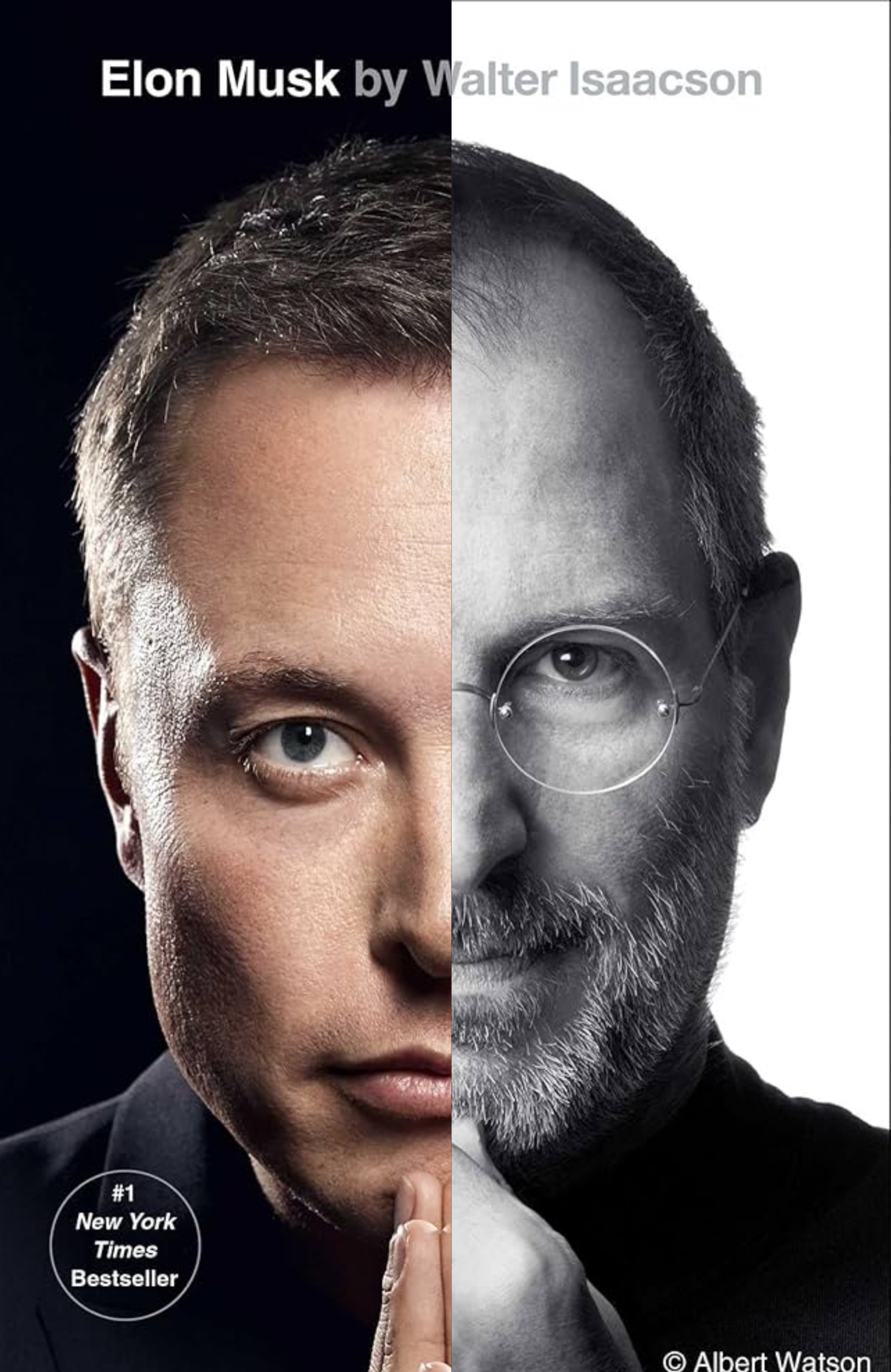

Walter Isaacson is my favorite author of biographies. In the past year, I have read his books featuring two of the most influential engineers/entrepreneurs, Elon Musk (2023) and Steve Jobs (2011).
Elon Musk is a contemporary engineer, businessman, and one of the world’s wealthiest individuals. He grew up in South Africa, where he learned to be curious. He faced a negative and sometimes abusive father who expected young Elon to be tough—but often used words such as “stupid.” Ironically, his father’s traits will be imprinted on Elon when he grows up and will help him become a successful person. But before that happened, Elon decided to move from South Africa to Canada and later to the US, where he founded notable companies like SpaceX and Tesla.
Steve Jobs was the pioneer who held the vision of the now ubiquitous technology. Steve Jobs was adopted by Paul and Clara Jobs and soon adopted his craftsmanship from his father, Paul, whom he deeply idolized. Though he constantly faced emotional challenges due to the nagging reminder that he felt both chosen and abandoned, he developed in Silicon Valley—and soon co-founded Apple with Steve Wozniak and Ronald Wayne on April 1, 1976. Steve Jobs quickly grew the company even during a long battle with a disease that was discovered with his diagnosis in 2003. This disease—pNET—proved fatal on October 5, 2011.
In the first half of the book…
Elon tried to buy rockets from the Russians but was turned down. Instead, he created his own space exploration equipment by recruiting engineers for his newly established company, SpaceX. He sought a vision far greater than Earth of transporting humans to Mars. He wanted to do this by creating a reusable rocket to save on transportation costs.
As a teenager and young adult, Jobs was drawn to Silicon Valley electronics, Zen Buddhism, the 1960s counterculture, and LSD and spiritual exploration. These experiences shaped his belief that technology should be intuitive, human-centered, and beautiful, not cold or mechanical.
Over the course of the book…
Elon Musk had many romantic relationships but often got into fights, putting those relationships in jeopardy. He isn’t the only child and has to support his siblings financially (except for Kimball, who is himself a billionaire). He gradually became a business celebrity and formed alliances with other public figures, which helped him expand his market for his companies. Even now, Elon Musk continues to improve his AI models, his autonomous driving, and his role as a father to his children.
Despite co-founding Apple, Jobs was pushed out after power struggles with CEO John Sculley and the board. His abrasive management style, impatience, and inexperience made him difficult to work with. But he learned to focus on collaboration—thus gaining leadership maturity—when he founded NeXT. After returning to Apple, the management was losing money, producing too many confusing products, and losing relevance compared to Microsoft, but Steve Jobs championed Apple as the future, carrying the company towards excellence.
Coherence of opposing experiences…
Elon Musk and Steve Jobs experienced bleakly contrasting childhoods, and while Elon was raised with a demanding father, Steve Jobs was scarred by his adoption past. Their determined—even defiant—ego led to success, even when no one thought it was possible. Although Elon is often seen as a successful person, we can also find many flaws in his personality, which also cost him many personal relationships. These same personality issues were the reason Steve Jobs was criticized by workers, but ultimately, they were part of what aided in both of their successes.
